

For decades, I’ve helped my clients change. Now it was my turn.
For as long as I can remember, I’ve wanted to clone myself—to create a twin that could bring my wish list to life.
Although conventional science has fallen short (perhaps a good thing), an unexpected catalyst became my genie in a bottle.
How the Pandemic Changed Law Firm Business Development Training
Covid-19 shut down the typical version of David Freeman, the one who ran retreats, conducted live training, and provided business development and leadership coaching. It all came to a screeching halt when law firms hunkered down and delayed investing in my services.
Which provided the unexpected gift of time. Time to reflect, to research, to collaborate, and build what had been relegated to the dusty confines of my “someday” list. Time to tap into the primordial ooze of creativity to birth a new, digital version of myself.
Why Lawyer Business Development Training Had to Evolve
As I navigate through this phase of my career, it would be easy to coast and do what I’ve always done. But that didn’t sit well with me, especially as I watched the shift to online education and the potential it holds when done right. Thus, I reflected on the structure and delivery of my work.
I’ve always been a change agent, focused on helping lawyers and law firms find new and better ways to attract, retain and grow work from excellent clients. While the existing model of live training and coaching worked relatively well, I knew in this new remote environment, I needed to revise my approach. I realized I had to meet people where they are. They have increased their consumption of remote training, they have shorter attention spans, they’re not reading books as much as before, they need help getting into action, and they crave community.
So I asked myself … How can I repackage three decades of my life’s work in ways that lawyers would actively engage with? How can I leverage technology to scale my training so it becomes easily accessible to all types of lawyers worldwide, from solo practitioners to partners in the world’s largest firms? How can I deliver training that is implemented and that gets people working together to achieve their goals? How can I create a legacy that lives on after I retire? Those were my queries, so I went deep to find answers.
How Modern Lawyers Prefer to Learn Business Development
Modern lawyer business development training must fit around time-consuming client work instead of competing with it. With a realistic training model, lawyers can learn the concept, apply it, and revisit it as needed.
- Brief sessions minimize the effort needed to begin and pursue training.
- On-demand availability lets the lawyer study in between clients, appointments, and other tasks.
- Practical applications relate the concept to present clients, potential clients, referral partners, and networks.
- Peer discussions offer an opportunity to compare strategies and learn from fellow lawyers.
- A follow-up system transforms a helpful concept into a repeatable business development strategy.
For firms that need a live layer alongside self-paced learning, David Freeman Consulting’s business development training and coaching combines interactive workshops with personalized planning and ongoing coaching. That makes it possible to use digital learning for scale while reserving live support for customization, implementation, and accountability.
Traditional Training vs. Flexible Online Learning
Legal firm training sessions may often focus learning in one sitting, while an online legal program can spread the learning process out. The table below shows some differences between the two training methods.
| Training Element | Traditional One-Time Session | Flexible Online Training |
|---|---|---|
| Access | Scheduled at a fixed time | Available when the lawyer can engage |
| Pace | Same pace for the full audience | Learners can pause, repeat, and revisit lessons |
| Reinforcement | Often depends on later follow-up | Can include reminders, worksheets, quizzes, and repeated practice |
| Scalability | Requires repeated live delivery | Can reach lawyers across offices and locations |
| Accountability | Usually separate from the session | Can be built into cohorts, buddy systems, and action tracking |
This is also reflected in the description of modern lawyer development by the American Bar Association’s Lawyer Development Lab as a coordinated, scalable approach and not an assortment of stand-alone programs that include self-paced material as one of the available options for development.
What a Modern Training Model Needs to Deliver
A better training program is more than just getting across business development concepts. It creates a framework that helps lawyers turn these concepts into something that sustains itself over time.
- Learning outcomes focused on business development behaviors.
- Practical examples consistent with what lawyers experience in their daily work with clients.
- Personalized approaches to business development rather than one-size-fits-all approaches.
- Repetition and reinforcement to ensure key actions aren’t forgotten.
- Accountability for lawyers to get their tasks done.
- Community learning around business development topics.
The Freeman business development ecosystem applies a similar sequence by connecting planning, skills development, and implementation rather than treating training as a one-time event.
How Adult Learning Research Shaped the Training Model
First, at the beginning of Covid-19, I formed a Zoom group of other front-of-the-room people who were similarly impacted by the shutdown of live events. This eclectic brain trust included trainers, keynote speakers, authors, professional musicians, marketers, event producers, a psychologist, a magician, a fighter pilot, an Army colonel, an Olympian, an image consultant, a PR expert, a TV producer, and a technology futurist. We met weekly for well over a year to support each other and share best practices for adapting and thriving in this new remote environment. The amazing cross-pollination of ideas was invaluable for seeing the world through a new lens and collecting innovative techniques.
At the same time, I consumed everything I could on the intersection of adult learning, technology, and remote training. I was on a mission to learn how to take what I’ve done for nearly thirty years and turn it into a virtual approach that had a real impact.
This lengthy period of learning and reflection led me to online courses. To that end, I started another Zoom group of people who were building online programs so we could share our lessons learned and accelerate our growth. I also convened a brainstorming session with over 80 in-house law firm training experts, where we collected best practices for running virtual training programs for lawyers.
What Makes Adult Learning Effective for Lawyers
Business development training for lawyers will be more effective if it values experienced professionals’ knowledge and gives them a motivating reason to use new information.
- Start with business development situations, not theoretical concepts.
- Let learners decide how to use new techniques.
- Provide examples of situations that vary in terms of seniority levels, areas of practice, and types of clients.
- Break behaviors into separate actions that learners can practice easily.
- Embed information in learners’ minds through repetition and review.
- Show progress so that participants understand the connection between actions and overall goals.
Similarly, research-based advice in the ERIC database of the U.S. Department of Education highlights that online instruction for adults should be based not only on appropriate design but also on delivery methods consistent with the process of adult learning. The evidence comes from more than just legal education, and it shows how online professional development can be organized with adult characteristics in mind.
Why Peer Learning Improves Business Development Practice
Lawyers always have something in common, even when they do things differently. Structured peer learning creates an opportunity for lawyers to learn from each other about what they need to do, the challenges they have faced, and how much work is needed to build the business.
- Cohort members can share solutions for staying in touch with contacts.
- Peers can exchange information on how to network and get visible.
- Discussions among peers will introduce lawyers to methods they don’t use in their practice areas.
- Peer coaching gives peers an opportunity to learn from real-life scenarios.
- Cross-office or cross-practice peers will strengthen internal relationships while building business skills.
Building a Scalable Lawyer Training Program With Experts
The late Joseph Campbell, an influential American writer who focused on comparative mythology, reminds us that we often need allies to complete our heroic missions. To build a program that would meet my expectations, I needed support to turn my vision into reality. That support came in two forms—my family and a virtual team.
Our youngest daughter, who was living with us during parts of Covid-19, built my website. Our son, who is a master of technology and obsessed with efficiency, spent five weeks with us starting in December of 2021, and got tired of hearing my “someday” list. As a result, within days of his arrival, boxes from Amazon magically appeared filled with lighting, greenscreens, tripods, and recording equipment. We cleared out an extra room and voilà, a studio was born.
Shooting the videos was only one part of the greater whole. We also needed an army of specialized talent, so my son dove into Fiverr and Upwork to fill the gaps.
The next thing you know, I have an international team of experts:
|
|
Which Skills Are Needed to Build a Digital Training Program
Scalable e-learning for lawyers cannot be achieved with subject-matter expertise alone. It also requires production, instructional design, technology, and support.
- Expertise in subject matter in identifying what the lawyers really need to learn and know.
- Instructional design in putting the lessons together in an organized learning sequence.
- Production of video and audio for lessons that will be easy to understand.
- Design of visual aids to simplify complicated concepts.
- Support in research and writing in developing examples and exercises.
- Support in technology for maintaining reliable access/downloads/course navigation.
How Specialized Contributors Improve Training Quality
Experts can enhance the learner experience in various ways without interfering with the core business development approach. They can simplify the learning process by improving access, comprehension, retention, and application.
- Editors can remove distractions and keep the video lesson on track.
- Designers can create visual continuity across lessons and supporting resources.
- Researchers can validate examples and support the learning structure.
- Course developers can arrange the modules, quizzes, progress tracking, and download options.
- Support staff can resolve access issues before they disrupt the learning process.
- Writers and production experts can customize information provided by the specialist.
Designing Online Business Development Training for Lawyers
From this alchemy arose an online, self-study training and coaching program, which I lovingly call “Digital David” but goes by the tradename Lawyer BookBuilder®.
It took me more than 1,000 hours to condense my life’s work in the realm of business development into 4 hours and 9 minutes of video content (specifically, 34 micro-lessons).
Concise, high-quality content, however, is not enough. The holy grail of training is getting participants to stick with the program, complete their tasks and continue to use the techniques after the training is over. This is especially challenging in a remote environment, where it’s harder to watch what people are doing.
As trainers, it is our obligation to not only provide information but to create environments that support implementation. To promote both learning and action, I filled Lawyer BookBuilder® with a boatload of advanced adult learning techniques. For my fellow geeks, here is a partial list of the magic tricks that are packed under the hood:
| homework | knowledge checks (quizzes) | social proof |
| deadlines | reframing | visualization |
| worksheets | storytelling | vocal tone |
| downloads | memory hooks | energy |
| scripts | quotes | emotion |
| stage setting | sound bites | personality |
| learning outcomes | metaphors | conversational |
| spaced learning | analogies | humor |
| repetition | research | empathy |
| summaries | progress measures | intrinsic rewards |
| graphics | small wins | praise |
Core Elements of an Effective Online Training Program
However, video instruction alone is not enough for effective online law business development training. A good course should include not only short-form education but also ways to remember and apply the knowledge in practice.
| Program Element | Role in the Learning Experience | Business Development Benefit |
|---|---|---|
| Micro-lessons | Break larger topics into manageable units | Makes it easier to learn around client work |
| Worksheets | Prompt reflection and written action | Converts concepts into personalized next steps |
| Knowledge checks | Require learners to retrieve key ideas | Reinforces important principles and terminology |
| Scripts and examples | Show how an approach can sound in practice | Reduces uncertainty when trying a new behavior |
| Progress measures | Show movement through the program | Creates momentum and a sense of completion |
| Cohort discussion | Adds peer reflection and accountability | Helps participants apply ideas to real situations |
This combination is achieved through Lawyer BookBuilder, where self-paced learning is paired with practical tools and accountability structures so the program can be used by individual lawyers or incorporated into a broader firmwide professional development initiative.
Why Micro-Lessons Work for Busy Legal Professionals
Micro-learning is especially effective for those who work in environments where their schedules change frequently. A short course lets learners focus on one behavior and practice it.
- One session can target one practical skill or decision-making issue at a time.
- Smaller sessions can be better incorporated into schedules amid commitments to clients and the organization.
- Learners can revisit one particular course without revisiting the entire seminar.
- Targeted courses make it easier to allocate topics to different categories of lawyers.
- A series of smaller sessions can lead to periodic interaction with business development strategies.
How Learning Techniques Turn Information Into Action
Remembering information from lawyer business development training is not enough; the goal is to take consistent actions that build relationships, increase visibility, follow up, and generate opportunities.
- Homework encourages the learner to use the concept in his or her own practice.
- A deadline motivates action now instead of delaying.
- Scripts decrease the resistance to starting an unusual conversation.
- Visualization and storytelling help learners remember concepts more easily.
- Progress measurements encourage small successes and ongoing involvement.
- Repetition and spacing review key concepts before they become irrelevant.
How to Make Lawyer Business Development Training Stick
While the techniques listed above help to move adults into action, we know lawyers are very busy, so without additional external stimuli, they may not follow through, no matter how many bells and whistles we bake into the process.
Therefore, throughout the program, I nudge them to create “Watchers” and personal reminder systems to “Guarantee” they will remind themselves to act on the steps they are prompted to take in this program. Below are some of the key elements.
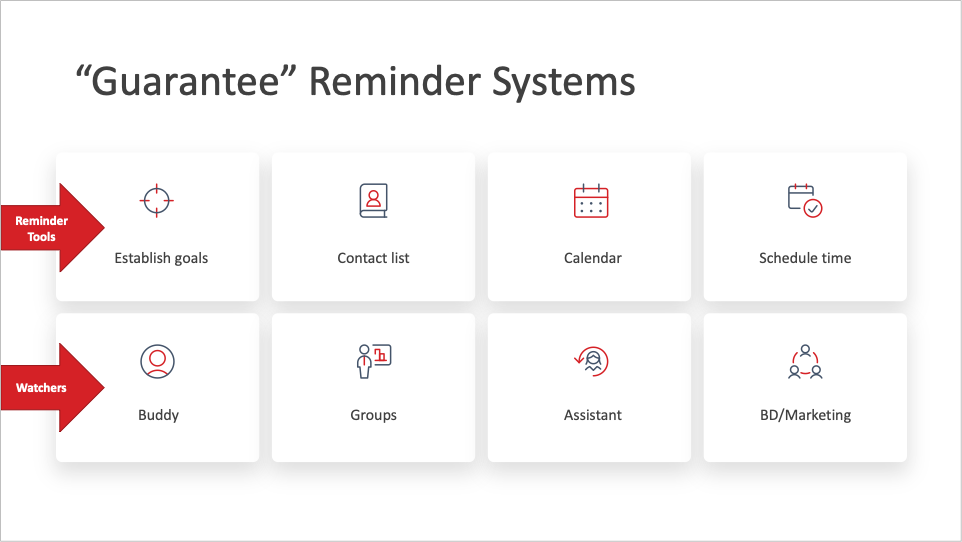
For solo and small firm lawyers, I suggest creating a buddy system, where they find another person equally if not more motivated to engage in business development and agree to a schedule where they regularly check in to hold each other accountable.
For firms with many lawyers, I strongly recommend forming cohort groups – pods of motivated lawyers across offices and/or practices who go through the modules together and debrief, perhaps monthly, to hold each other accountable on the action steps, share best practices, peer coach each other, and overall form deeper relationships.

To support the process, I developed a “Cohort Group Leaders Guide” (see graphic to right) to help make forming and implementing cohort groups a turnkey process using internal firm resources so firms don’t have to rely on an outside consultant to run the sessions.
Accountability Methods That Support Follow-Through
Accountability methods may vary based on the size of the organization, participants’ seniority, and the availability of internal support. The methods below show how personal, peer, cohort, and managerial follow-up can foster accountability.
| Accountability Method | Best Fit | How It Supports Action |
|---|---|---|
| Personal reminders | Any individual learner | Keeps agreed actions visible between lessons |
| Buddy system | Solo and small firm lawyers | Creates a simple recurring check-in with one peer |
| Cohort group | Firms with multiple participants | Adds shared learning, discussion, and peer accountability |
| Progress tracking | Individuals or firm programs | Makes completion and activity easier to review |
| Leader check-ins | Structured firm initiatives | Connects training activity to broader development goals |
At the technology level, BD Buddy can be used for accountability by making use of prompting, coaching, and tracking of activities. Such a system can help achieve the goal of accountability even when firms are looking for follow-up outside of coaching sessions, group discussions, or training sessions.
How Cohort Groups Reinforce Business Development Habits
Through cohorts, a recurring space emerges where attorneys can discuss implementation, not just content. This repeated interaction can make business development efforts more visible and sustainable.
- Attendees may report on tasks accomplished since the last meeting.
- The lawyers can work out ways of overcoming barriers in discussions with like-minded professionals who know firm culture well.
- The members can exchange language and strategies that have proven themselves in practice.
- Cross-practice cohorts can identify opportunities for internal collaboration and cross-servicing.
- Group leaders can keep meetings action-oriented and prevent them from turning into general discussions.
Lawyer BookBuilder can also be used with cohort accountability, giving lawyers structured material to work through while group discussions focus on how those lessons apply to real clients, relationships, and business development opportunities.
How Solo Lawyers Can Build Accountability Without a Firm
Solo practitioners don’t need a formal professional development department to build an organizational framework for business development. An effective accountability system can solve many of these issues.
- Select a motivated peer who is compatible with you.
- Establish a consistent time frame for your weekly or monthly meeting.
- Develop a plan for certain actions before the meeting.
- Monitor your outreach, follow-ups, meetings, visibility, and opportunities.
- Speak about the positive and negative aspects of your efforts instead of the numbers.
- Revise the plan if your client situation changes.
Structuring Business Development Content for Better Learning
To begin the daunting process of identifying and condensing content, I started by sweeping through my nearly 30 years of presentations, books, articles, videos, and coaching notes to compile my “greatest hits” in each major category of becoming a highly effective rainmaker.
The graphic below—in essence, my table of contents—is where I landed.
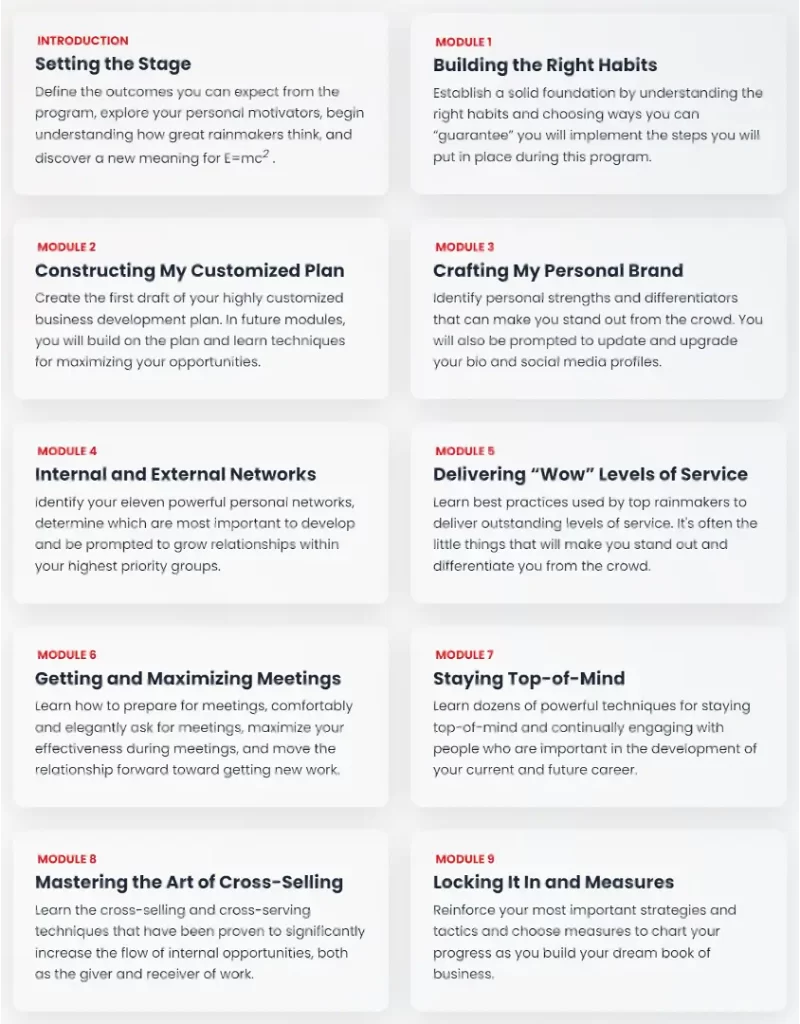
After plucking the gems from the reams of content I’d collected, the focus shifted to maximizing the user experience. That began with the look and feel of the images in the videos, with the goal of creating a visual journey that aligned with the story I was telling of how to become a better business developer.
A graphic designer I am not, so I found a slide design expert who took the mosh pit of images I’ve used over decades of delivering my training programs and turned them into a set of consistent, clean graphics that make it easy to follow and remember the key points of my narrative.
While pictures tell a thousand words, good metaphors communicate a thousand pictures. There are so many factors that go into learning a skill, so distilling key concepts into words and short phrases can serve as extremely powerful memory aids.
For example, to stay top-of-mind, it is important that lawyers use tools that get them seen by wide audiences. I call these tools
“Amplifiers,” which is a word (along with a good image) that captures the concept and creates mental pictures of various approaches for doing so.

Another example is cross-selling. In the minds of many lawyers, cross-selling has a distasteful connotation—who wants to be seen as “selling” another service to a client?
Thus, I reframe the concept to “cross-serving,” which triggers thoughts and actions in alignment with the desired outcome—to be in service to clients by providing value and to address needs they have in other legal areas.

How to Organize Business Development Skills Into a Learning Path
A defined learning pathway helps lawyers understand how individual skills contribute to the overall process of developing their practice. Rather than offering many separate tips, the training program should organize related behaviors into a more memorable process.
- Start by setting goals, defining the right mindset, and the lawyer’s position on business development.
- Choose your target clients, referral sources, networks, and internal connections.
- Gain visibility and credibility using the right “Amplifiers.”
- Enhance your ability to develop relationships and meet effectively.
- Put follow-up processes in place to keep key contacts top of mind.
- Relate client services, cross-serving, and opportunity creation to growth.
Why Visuals and Metaphors Improve Recall
Business development is a process with many activities that may seem abstract when explained using technical terms. Graphics and memorable terminology are an alternative route to the concept behind the description.
- A graphic can become a retrieval trigger for a concept.
- Terminology will limit the number of words that need to be remembered.
- Metaphors will make the behavior easier to understand.
- Reframing will eliminate the negative connotations that prevent the action from taking place.
- Graphic patterns help the individual understand their position in the overall process.
- Memorable terminology gives learners a common language for discussing implementation.
How to Connect Training Content to Real Client Development
The material is more valuable when learners can quickly connect it to people and prospects in their existing practice. Each module should motivate the lawyer to take a practical next step.
- Use networking techniques with clients and referral sources.
- Implement visibility techniques around subjects the lawyer truly understands.
- Practice meeting skills before a scheduled conversation with a client or prospect.
- Develop cross-selling initiatives based on the client’s known needs.
- Create follow-up plans for prospects that have become dormant.
- Utilize worksheets to turn generic goals into concrete people and plans.
Using Worksheets and Tools to Reinforce Business Development
So much learning is a passive exercise, so from time to time throughout the program, I prompt the user to stop the video and write action steps into a master worksheet I provide.
The worksheet’s purpose is to get the learner to reflect on the topic more deeply and personalize it to their own situations. It also becomes fodder for discussion in the cohort sessions and can be tracked for accountability.
Below is an example of prompts in the master worksheet:

I also include other supportive materials, like checklists, other worksheets, scripts, and articles, so they have materials they can refer to outside of the videos.
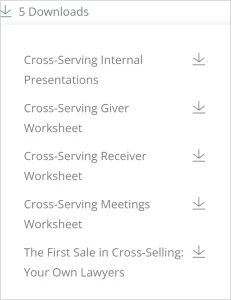
For example, as shown in the image to the right, cross-selling (or cross-serving as we call it) has many downloadable tools to support different situations relating to the lifecycle of the process.
Another tool I use is quizzes at the end of each module. Now, these are not designed to test knowledge as much as it’s a way to aid the retention of important material. I also like to use humor, since it taps into another part of the brain to reinforce the message.
Which Support Materials Help Lawyers Apply What They Learn
Practice tools give lawyers practical tools to use after a training session. The most helpful tools help you connect learning to specific steps toward developing your business.
| Support Material | Primary Purpose | Practical Application |
|---|---|---|
| Master worksheet | Personalize lessons | Records goals, contacts, ideas, and next steps |
| Checklists | Reduce missed steps | Guides repeatable business development activities |
| Scripts | Provide starting language | Helps with outreach, meetings, follow-up, and cross-serving conversations |
| Quizzes | Reinforce retrieval | Brings important concepts back to mind after a lesson |
| Articles and downloads | Extend learning | Gives lawyers reference material outside the course |
| Cohort discussion prompts | Structure reflection | Helps groups discuss progress and obstacles consistently |
How Worksheets Convert Ideas Into Action Steps
The worksheet serves as an intermission between hearing the concept and going on to the next one. The break lets the learner consider how the concept applies to practice.
- Name the individual client, prospect, or referral source that goes with the concept you have learned.
- Specify the next action rather than just recording a general intention.
- Set a time or reminder so your action doesn’t get lost in your task list.
- Identify the kind of preparation, information, or introduction you need before proceeding.
- Bring your filled-in worksheets to your cohort or coaching sessions.
- Review old worksheets to discover what kinds of behavior lead to productive interactions.
How Quizzes and Checklists Reinforce Retention
While quizzes and checklists serve different purposes, both can help minimize the disconnect between learning and doing. Both give lawyers a quick way to recall and apply core ideas.
- Quizzes help lawyers remember critical ideas right after a course.
- Checklists can show which ideas must be repeated during review.
- Checklists reduce cognitive effort during repetitive tasks.
- Guided steps can help lawyers get through a difficult business development activity.
- Repeatable methods ensure consistency across clients and situations.
- Humor and different types of tests can make reinforcing ideas less intimidating.
Who Benefits Most From Online Business Development Training
I’ve spoken with scores of firms who see many ways a scalable, online program like Lawyer BookBuilder® fills gaps they have in their training curriculum. Some see this as a great fit for senior associates and counsel who need to develop skills now to prepare for becoming partners. Others have expressed interest in using this model to bring cross-practices together to learn more about each other to increase cross-selling.
More significantly, many of my law firm contacts are telling me that online training is the likely solution for the new hybrid workforce and how on-demand learning fits better with the busy and unpredictable lifestyles of their lawyers. Some see the program as a great “graduation gift” for new partners to help them connect with each other and support their journey to become powerful rainmakers. Others see benefits for other populations, like new laterals and internal affinity groups as places where this type of training could thrive.
Perhaps the most obvious and important, however, is the individual lawyer who is not necessarily affiliated with a law firm with a substantial professional development budget—which, frankly, is the majority of lawyers. My professional journey has enabled me to improve the quality, consistency, and availability of my life’s work while also dropping the per-unit cost, which means my digital clone can deliver my services to a much wider audience than I could reach on my own.
Lawyer Groups That Can Benefit From Online Training
Online business development training may be useful for lawyers at different stages of their careers, though the need will not be the same for everyone. The following table matches some groups of lawyers to the specific areas where training can help them develop.
| Lawyer Group | Development Need | How Online Training Can Help |
|---|---|---|
| Senior associates | Prepare for greater responsibility and future partnership | Builds foundational client development skills before the transition |
| Counsel | Expand relationships and visibility | Provides a structured path for strengthening business development activity |
| New partners | Adjust to increased expectations for growth | Creates a practical system for building rainmaker habits |
| Laterals | Rebuild internal and external networks in a new firm | Supports integration, relationship mapping, and opportunity development |
| Cross-practice cohorts | Learn how colleagues serve clients | Creates shared language and can support cross-serving |
| Solo and small firm lawyers | Access structured development without a large training budget | Provides scalable, self-paced learning with optional peer accountability |
How Law Firms Can Use Training Across Career Stages
One model for training associates in business development can serve multiple groups, depending on the examples, activities, and accountability built in for each group based on its level of responsibility.
- Associates can begin networking, building visibility, and building relationships before it becomes crucial to generate business.
- Senior associates and counsel can leverage their relationships into a systematic development program.
- New partners can improve opportunity management, client development, and follow-through.
- Existing partners can further hone cross-selling, key-client development, and leadership of business development initiatives.
- Laterals can use the model to integrate into the new firm and reconnect their networks.
- The marketing and business development team can bolster the model through implementation and measurement.
When a firm needs role-specific customization, David Freeman Consulting can layer training and coaching around different lawyer populations rather than forcing the same business development approach across every career stage.
When Self-Paced Training Makes Sense for Individual Lawyers
Self-paced online training is especially beneficial when a lawyer needs structure but can’t enroll in a pre-set program schedule. Self-paced learning also lets the learner refresh business development knowledge as needs change.
- The lawyer learns on their own or lacks access to an organization-wide program.
- Client needs prevent regular attendance at live training sessions.
- The learner wants to review certain aspects of business development before a meeting, conference, or marketing campaign.
- A lawyer needs to develop a new career-stage strategy that includes business development.
- Some prefer to study privately and only then discuss plans with a coach or mentor.
Self-paced learning may also work with an implementation aid like BD Buddy if the major barrier is not access to information, but executing the business development steps.
“The Future Is Already Here”: Modern Lawyer Business Development
The above quote, penned by science fiction writer William Gibson, tells it all – the future of developing lawyers to become better business developers is already here, but not everyone knows it.
The “gift” of Covid-19 allowed me to go wide, to tap into advances in technology, adult learning, motivation, organizational behavior, and client development to bring the leading edge of training and implementation to my slice of the world. By creating new ways to make my work easier for lawyers to access, absorb, and act on, I’m hoping to distribute the future of how to become a great rainmaker more evenly throughout the profession.
Frequently Asked Questions About Lawyer Business Development Training
What is business development training for lawyers?
Business development training for lawyers teaches practical ways to build professional relationships, strengthen visibility, develop client opportunities, grow existing accounts, and create consistent follow-up habits. At David Freeman Consulting, business development training is designed around practical application, giving lawyers actions they can adapt to their practice, personality, clients, and market.
How is online business development training different from a live workshop?
Online business development training can be completed in smaller segments and revisited when a lawyer needs a specific skill or reminder. Live workshops can create strong real-time interaction, while online programs make it easier to combine self-paced lessons with worksheets, quizzes, reminders, cohorts, and other forms of ongoing reinforcement.
Who should receive law firm business development training?
It benefits several career stages, including senior associates, counsel, junior partners, senior partners, lateral hires, and solo practitioners. However, the training program should shift depending on the professional’s position: young lawyers need more basic relationship-building and visibility skills, while partners need stronger systems for client growth, cross-selling, and accountability.
How long should a lawyer business development program take?
Since it is a question of acquiring knowledge versus implementing it into practice, there isn’t one optimal time frame. However, while shorter classes can help people understand the material, real behavior change takes time and more than one lesson.
What makes business development training more likely to stick?
Training is more likely to lead to behavior change when it includes hands-on activities, prompts, worksheets, repetition, tangible actions, and accountability. David Freeman Consulting reinforces this approach through practical tools, structured learning, and accountability methods that help lawyers continue using business development techniques after training ends.
How can a law firm measure whether business development training is working?
A law firm could track both participation and behavior in addition to just results. The evaluation should consider how many lessons have been taken, action plans developed, outreach efforts made, follow-ups conducted, clients and prospects met with, internal introductions, cross-serves discussions, opportunities generated, and progress towards personal business development objectives.
* * *
Originally Published on Legal Evolution | Nov 2022

